

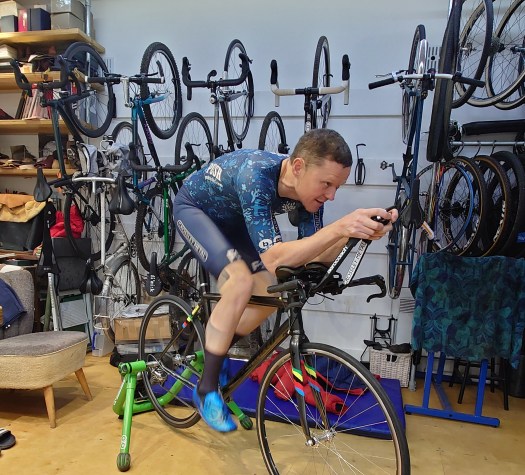
High Hands, Praying Mantis, call it what you will. But anybody involved in or interested in Time Trial, Triathlon or Pursuiting will be familiar with the now common elevated hand position adopted by many riders. Is it faster? Is it more comfortable? The question is, is it right for you?
The answer is of course, it depends. As with many decisions relating to an aero position, it is a case of weighing up priorities, combining them with anatomical attributes and deciding how discipline specific you want the positon to be.
As far as aerodynamics are concerned, the data trends toward the higher hand position allowing riders to reduce their CDA through a wider range of torso angles than the ‘low hands’ position. This is preferable for a large proportion of riders from any discipline, who compromise their function and power output to an unacceptable extent in order to achieve the lower torso angles long favoured by many high profile riders. By elevating the hands, a rider can more effectively close the disturbed air space between their arms and hitting their torso and even face, ‘cutting’ the air and pushing more around their body. But this is far from universal. For those riders able to adopt a very low torso angle and clean connection between the head and shoulders, it is still possible for a lower hands position to be more effective across a range of yaw angles, critical to consider in real world conditions.
Where things become the most individual is when we look at the function, comfort and musculature of a given rider, taking this in to their chosen discipline. In my experience, a large proportion of athletes are able to adapt (with appropriate proprioceptive cues) to a higher hands position with very little issue. For shorter distance events, it can be very effective in assisting riders to ‘turtle’ their heads, close up and reduce their exposure to the wind. For long distance events, it can greatly help a rider to actually do the opposite and keep their shoulder dropped, reducing neck and shoulder fatigue.
However, there are many cases where we can observe the opposite. For some riders, the slight lengthening effect combined with shoulder rotation does not fit their musculature or mobility and may also depend on their effective degree of pelvic rotation. This can lead to a greater demand on the ‘core’ and the spinal erectors, dismantling the integrity and stability of the position from the inside out.
For other riders, the same elevation and rotation of the forearm which is so pivotal in aiding one rider to reduce their shoulder tension can cause the exact mirror response and see the rider shrug their shoulders increasingly toward their ears and generate a ball of tension in their upper lats and neck. This may be a worthwhile tradeoff for many a 10 mile tester, but for an Ironman triathlete this could be a day ender.
 AC Performance Bike Fit