

This post comes with a few caveats and assumptions…
The first is that you have already had a read through my first two posts, outlining some broad differences between modern saddles and some of their implications to the rider.
If you havn’t, you can find links below:
Saddle Profile Pt.1 – Why size isn’t everything.
One doesn’t need to think back too far to a…
Saddle Profile Pt.2 – Three Dimensionality
In the previous post, we looked at how a ‘wide’…
The second is that all of this advice is written assuming that other elements in the fit are at least within a functional range. In particular the very basics of saddle height, saddle setback and overall cockpit reach. It is not uncommon to come across a client with a bag full of saddles which “don’t work,” only to end up back on one of those saddles, because the issue was somewhere else in the setup.
I have a short post on a couple of overlooked fundamentals when establishing saddle height. It’s unlikely to be the last post on this subject. I also have in the pipeline a post addressing the foundations of saddle setback.
Establishing Saddle Height.
Many factors influence the functional saddle height range of an…
The third is that you have a good grasp of your functional ability and postural control cues. First and foremost, the ability to hinge at the hip while retaining some degree of spine neutrality. This is unfortunately difficult for some clients and often even more challenging for riders who have spent a long time riding with a high degree of spinal flexion. My clients are familiar with how much I drive this point. Without this as a starting point, it is nearly impossible to then move forward and really understand how the saddle will work for us.
This leads nicely in to things to bear in mind when selecting a saddle…

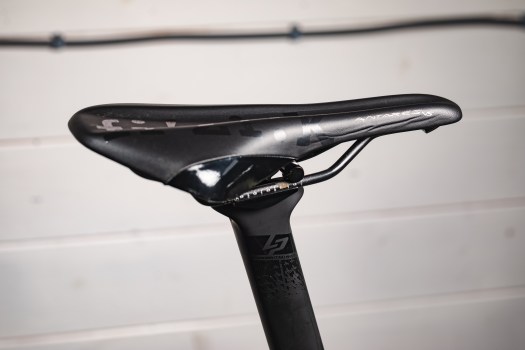
The first and arguably most important and most regularly unrealised point to consider when selecting a saddle is:
A Saddle should support your DESIRED position, NOT the one it FORCES you in to.
This seems obvious, but the vast majority of riders I see are driven to compromise their posture and their position to meet the offerings of an inappropriate saddle. If your saddle forces you to tuck your pelvis or move off to one side through lack of support or pressure relief, it’s not the one for you.
Second:
Your saddle should be relatively level.
If you need to tip the nose of the saddle more than a few degrees down to the point it causes you to be always sliding forward, it’s not doing its job.
Next up:
You want the WIDEST saddle possible.
The saddle is the base of support for the pelvis. The influences everything both above and below it. The obvjective should be for the pelvis to be as ‘quiet’ and stable as possible. When I say possible, this means the broadest base of support which does not hamper function, interfere with muscle connections or cause chaffing or rubbing, anywhere on the shell. This is very likely to be wider, or narrower than what your sit bone measurement told you. Also always keep in mind that two saddles of the same measured width may present an entirely different contact patch due to differences in their profile.
Next:
Flat saddle are rubbish.
Choosing a pan flat saddle allows anybody to easily get to 90% acceptability and never beyond it. Your pelvis isn’t flat. Your pubic rami are curved. Our objective is to stabilise the pelvis. This is simply a case of round peg, square hole.
Lastly:
If you need a high degree of padding, it’s not the one for you.
Highly padded saddles provide a huge margin for error when initially setting up a bike. It doesn’t provide the desired stability and base for power production. Padding masks poor profile matching between pelvis and saddle. Sinking in to padding is an excellent way to spread pressure on to soft tissue and other places we don’t want pressure. Worse than this, padding compresses relatively quickly, meaning that saddle height you obsessively set with your finest tape measure has now effectively dropped within a handful of rides.
Finding a saddle can be a minefield, which explains why so many settle for mediocre choices, or put up with postural issues at least partly driven by their selection. I hope that helps give a summary of the core principles that you should look for when trying to find a saddle.
If you’re lost in the saddle wilderness, or the “right” saddle for you still isn’t cutting it, reach out, either by phone or email and I’ll get back to you. The primary goal of all of this is to provide some clarity and help to all riders, as much as I can.
 AC Performance Bike Fit